The interview skill nobody teaches you.
I couldn't answer most of the questions. 48 hours later, they offered me the job.
I was a chemical engineering co-op student at the University of Waterloo. That year, the petrochemical market had dropped and chemical engineering co-op jobs had all but disappeared. So Waterloo sent my resume out to a whole pile of places, hoping something would stick.
One evening over Christmas break, right after exams, the phone rang. It was the Canadian International Trade Tribunal.
Neither my mom nor I had ever heard of it. She was pretty sure someone was pulling my leg.
They weren't. They were interviewing me, right there on the phone, for a job starting in January.
The questions were all about trade between Canada and the US. I recognized a few ideas from high school economics. The rest, I honestly didn't know.
So I told them that.
The role was a statistician researching the movement of cattle between Canada and the US for a federal inquiry into the cattle and beef industries. I didn't know trade. But I'm a farm girl, and I knew cows.
I hung up sure that was the end of it. 2 days later, they called back with an offer.
I had no idea why. It took me 6 weeks to find out, and their answer changed how I think about interviews.
Interview Advice Assumes Someone Trained the Interviewer
Most interview advice sounds the same. Research the company. Prepare your stories. Master the STAR method: Situation, Task, Action, Result.
All of it assumes the person across the table knows how to run an interview.
Many don't.
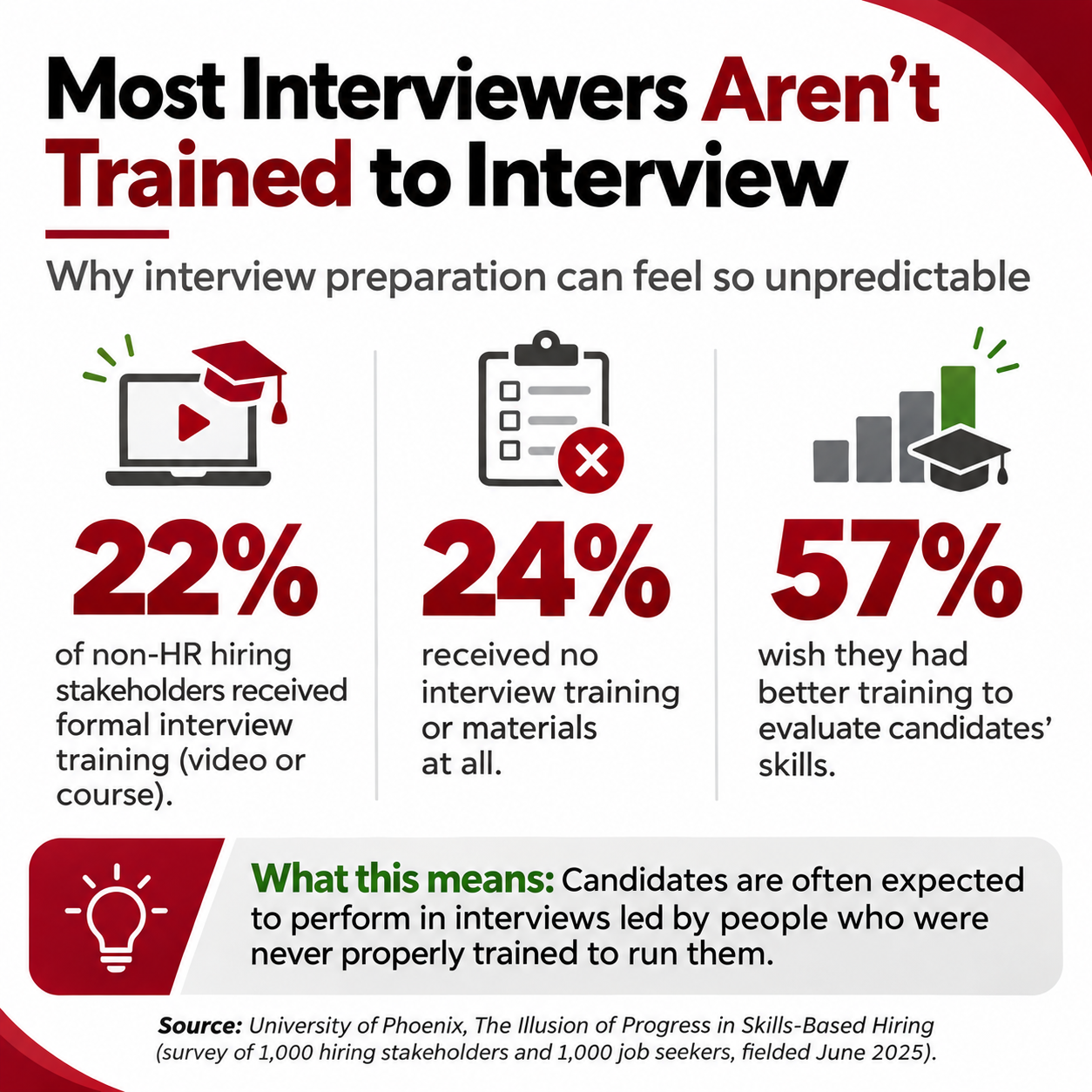
In a 2025 University of Phoenix survey of US hiring stakeholders, only 22% of those outside HR had received formal interview training through a video or course. 24% had no training or materials at all. And 57% of hiring stakeholders wished they had better training to evaluate candidates' skills.
That's US data, and it matches what I've seen in Canada.
Over my career, I've been interviewed by a single person holding my resume, and by panels of 8 or 9 people quizzing me on technical depth and leadership. Most of them never used STAR. Most had never been formally trained to interview.
So you can walk in with perfect answers and meet someone who doesn't know which questions to ask. Or someone who asks what your spirit animal is.
STAR Organizes Your Answer. It Doesn't Run the Conversation.
STAR is a good tool. I learned it at Bayer early in my career, when I got formal interviewer training. I saw how behavioural questions were built, and I used that process rigorously to interview co-op students and new hires.
But I'd learned to interview long before that.
At Waterloo, I went out on 6 work terms. Nobody ever taught me interview skills. I learned by sitting in a lot of interviews. By the time I graduated, I was getting an offer from nearly every interview I landed.
It wasn't because of STAR. I'd never heard of it. It was because I'd learned to adapt to the person across from me. I adjusted my questions, my language and my pace. I treated interviews as conversations, not tests.
STAR is an answer-delivery framework, not a conversation strategy.
It tells you how to organize a story. It doesn't tell you how to read the person hearing it, what to do when a question comes out of left field, or how to build rapport before the first question is even asked.
And rapport matters more than most candidates think. Researchers Barrick, Swider and Stewart found that the impressions interviewers formed in the opening rapport-building minutes were linked to how they rated candidates later, and to who received offers.
The first few minutes set the tone for every answer that follows.
Rapport Before Response
My last formal interview, I didn't know I was in one.
Someone reached out on LinkedIn looking for help with what sounded like an administrative role. I agreed to a coffee chat. I was in a senior role, comfortable in my job, and not looking to move.
So there I was at Tim Hortons, and the person across from me pulled up my LinkedIn profile and started interviewing me.
I said, "What are we doing here?"
"I'm interviewing you for the position."
"I haven't applied for the position. Tell me about the role. What are you looking for?"
From there, it became a conversation. I knew the company well. I'd actually hired them as a contractor. So I asked questions, challenged whether it was a fit, and listened to where they wanted to take the business.
Then she asked if I'd meet the president. He and I got along really well. But I told him he wasn't the person I'd work with day to day, so he shouldn't be the one deciding whether I fit the team. That led to a relaxed conversation with the 2 leaders of the division.
No script. No STAR answers. Just 3 conversations.
You won't always walk in that unprepared. But you will often walk in with someone who hasn't been trained. So what do you do?
Build rapport before the formal questions. Be attentive and genuine. Notice how they greet you, how fast they talk and what they ask about first.
Read how they prefer to communicate. I use 4 leadership communication styles as cues, not labels:
Director: wants results and action
Collaborator: wants questions and detail
Connector: wants relationships and how people were involved
Innovator: wants energy and the big picture
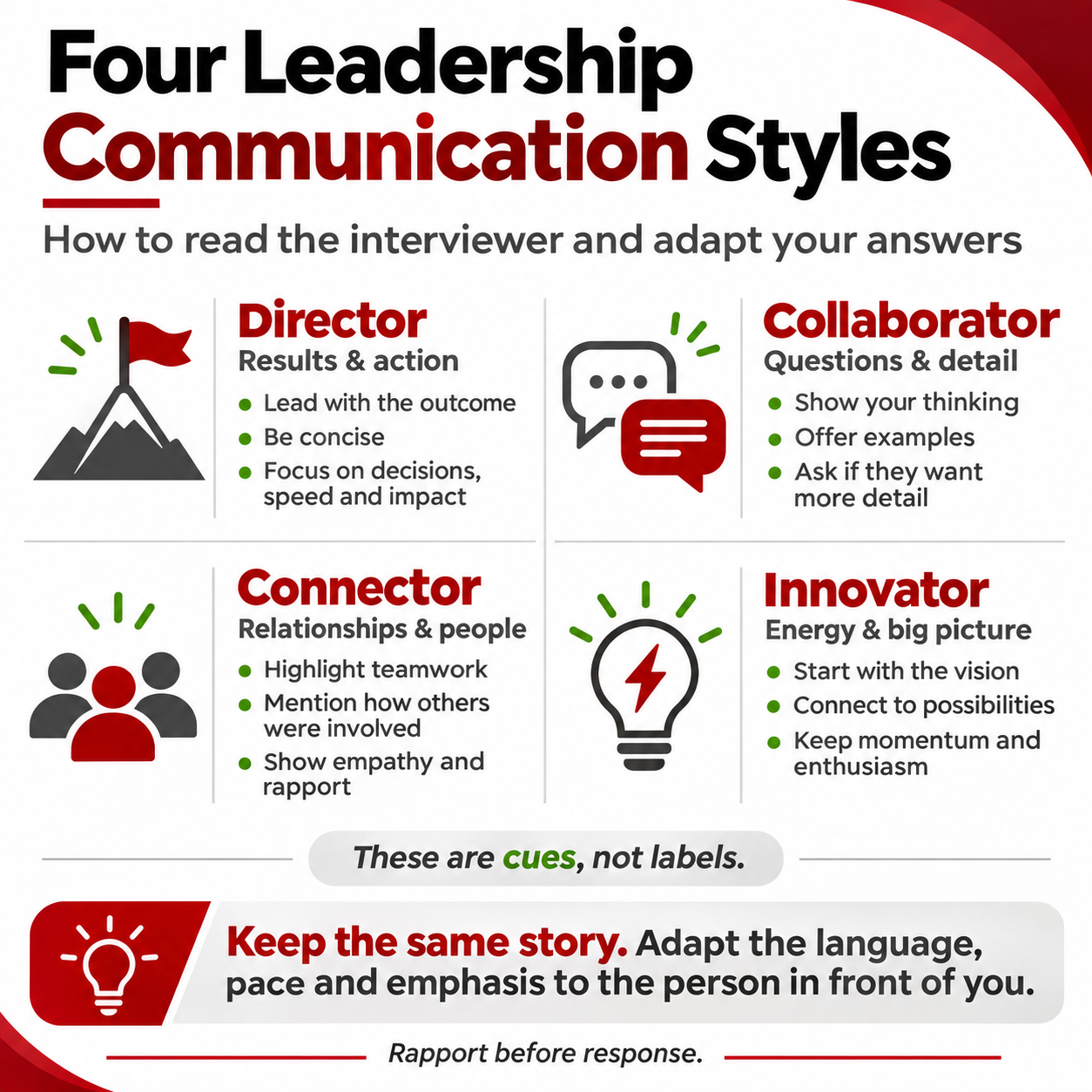
Adapt the same STAR answer to the listener. Keep your story. Change how you tell it. For a Director, lead with the result. For a Collaborator, offer the detail and ask if they'd like more. Match your language, tone and pace to theirs.
Stay honest with unexpected questions. If a question seems irrelevant, it's fine to ask what they're hoping to learn. If you don't know, say so. Don't invent an answer.
Make it a 2-way conversation. Ask about the scope, what success looks like and whether the fit works for both of you.
Why They Really Hired Me
Back to the Trade Tribunal.
About 6 weeks into that work term, the team took me out for a Chinese New Year lunch. Waterloo had an excellent international trade co-op program, and this was a premium job. By then, I knew the team well enough to ask the question I'd been carrying since that phone call.
"Why did you hire me? I have no background in international trade."
They gave me 3 reasons.
First, I'd grown up on a farm. If they sent me to an abattoir or out to do research, they knew I'd be comfortable. They were right.
Second, a US president had a background in engineering. They figured if he could be president, I could do this job.
Third, even though I didn't know the answers, I didn't lie to them. I was open and honest. My credibility held up because I had a confidence in that call that made them believe I could do the role.
None of those reasons was a polished answer.
When rapport is poor, every answer has to overcome the first impression. When rapport is strong, every answer gets the chance to reinforce it.
That's rapport before response.
And if you're the one doing the interviewing, that's a conversation for another day.
You Don't Have to Be at the Mercy of the Interviewer
Imagine walking into your next interview and reading the person across from you in the first few minutes. You hear what they care about. You tell the story you prepared, in the way they need to hear it. And when a question comes out of nowhere, you stay steady, honest and yourself.
You're no longer waiting to be tested. You're in the conversation.
It starts with knowing your own style. Take the free Leadership Communication Style Quiz to see how you naturally show up, and where you'll need to adapt: https://engineeringbetterconversations.scoreapp.com/
A fun footnote
If you're wondering whether I really landed that job researching cows, you can still find my name on page 176 of the Canadian International Trade Tribunal's 1993 report, An Inquiry into the Competitiveness of the Canadian Cattle and Beef Industries (Inquiry GC-92-001). It's listed under the Research Branch, Statistics, with an asterisk beside it marking me as temporary staff.
View the original government report (PDF)
Proof that you don't need to know all the answers to land the job.
Sources to link at publish:
University of Phoenix, The Illusion of Progress in Skills-Based Hiring (2026), pp. 11-12, 26: https://www.phoenix.edu/content/dam/edu/career-institute/doc/uopx-skills-based-hiring.pdf ;
Barrick, Swider & Stewart (2010), Initial Evaluations in the Interview: https://doi.org/10.1037/a0019918